Clipboard folio as commonplace book
A quick look at using a clipboard as a commonplace book, including:
- What is a commonplace book?
- What I've done in the past
- How I'll use the clipboard
What is a commonplace book?
Commonplace books have a long history. From Wikipedia:
Commonplace books (or commonplaces) are a way to compile knowledge, usually by writing information into books. They have been kept from antiquity, and were kept particularly during the Renaissance and in the nineteenth century. Such books are similar to scrapbooks filled with items of many kinds: sententiae (often with the compiler's responses), notes, proverbs, adages, aphorisms, maxims, quotes, letters, poems, tables of weights and measures, prayers, legal formulas, and recipes. Wikipedia | Commonplace book
Great, now let's look up "sententiae":
Brief moral sayings, such as proverbs, adages, aphorisms, maxims, or apophthegms taken from ancient or popular or other sources, often quoted without context. Wikipedia | Sententia
It's also worth noting what they're not:
Entries are most often organized under systematic subject headings and differ functionally from journals or diaries, which are chronological and introspective. Wikipedia | Commonplace book
So a commonplace book is a way to collect, record, and organise anything of interest to you, with a focus on categorised information and quotes rather than chronological diaries or reflective journaling.
My current system
My current system doesn't really deserve the name 'system'. I take notes. A lot. But I tend to try and organise things into categories by giving them their own notebooks. This results in a lot of part-used notebooks, and a huge, impractical stack of books, that I never have to hand when I want it. These notebooks are in addition to my journal, my five year journal, my planner(s) . . . you see the problem.
Enter the clipboard
A clipboard folio is my attempt to bring order to this chaos. With the clipboard I'll use A5 paper, punched for a six ring folio. I'll also keep a small notepad in it, and a pen.
The small notebook will be for quick notes that I don't expect to keep. Meanwhile, the A5 paper will replace all my notebooks, apart from my journals and planners. This means no part-finished books, and one single portable place to keep notes. The clipboard will mean writing on the go will be easier. It also makes my notes far easier to organise: folios and folders with multiple tabs for different topics can store the notes in whatever categories I choose.
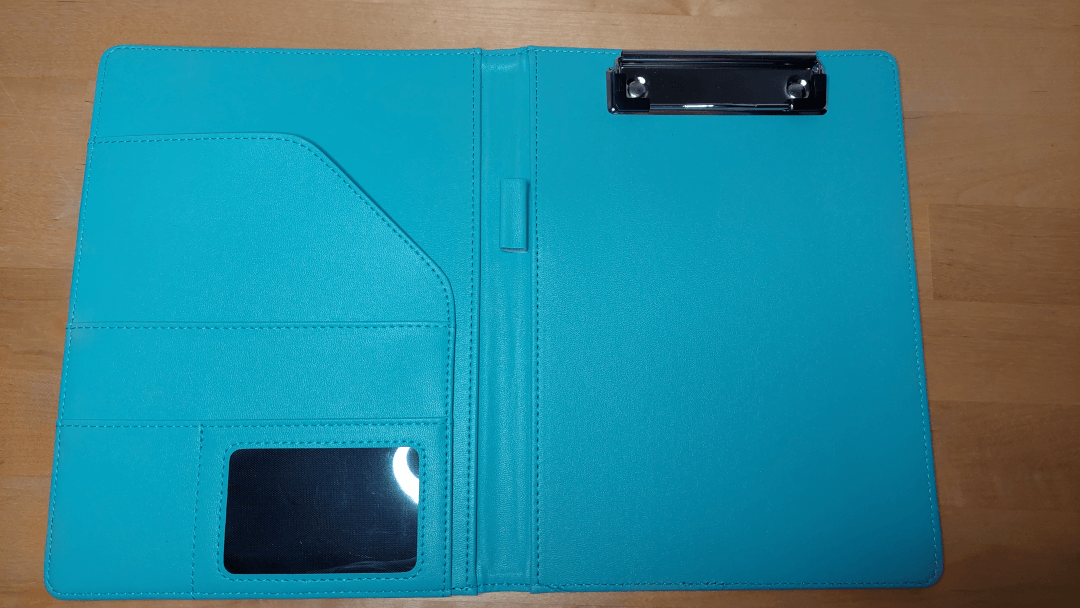
The specific cliboard folder I got was a cheap-and-cheerful option on Amazon. It's colourful, and feels surprisingly good in hand. However the pen loop is slightly pointless, as putting a pen in it prevents it closing properly. However, for a cheap generic folio, I'm not too bothered by this.

Colours
This clipboard is impossible to photograph. In my pictures it looks blue. Even in the original product pictures it's a greenish-blue. In person, it's closer to a pale green. It's a nice colour - just not exactly as photographed!
Wrap up
I'm excited to try this approach to note taking. At minimum I should be able to merge a bunch of notebooks, and have something I can always carry with me. I'm hoping it'll help me be a bit more organised and thorough in how I take notes, especially when reading. This should be helpful for future projects: both blog posts and videos for Spacious Planning where I actually need to prep, but also for any future studying.